Publish and Flourish
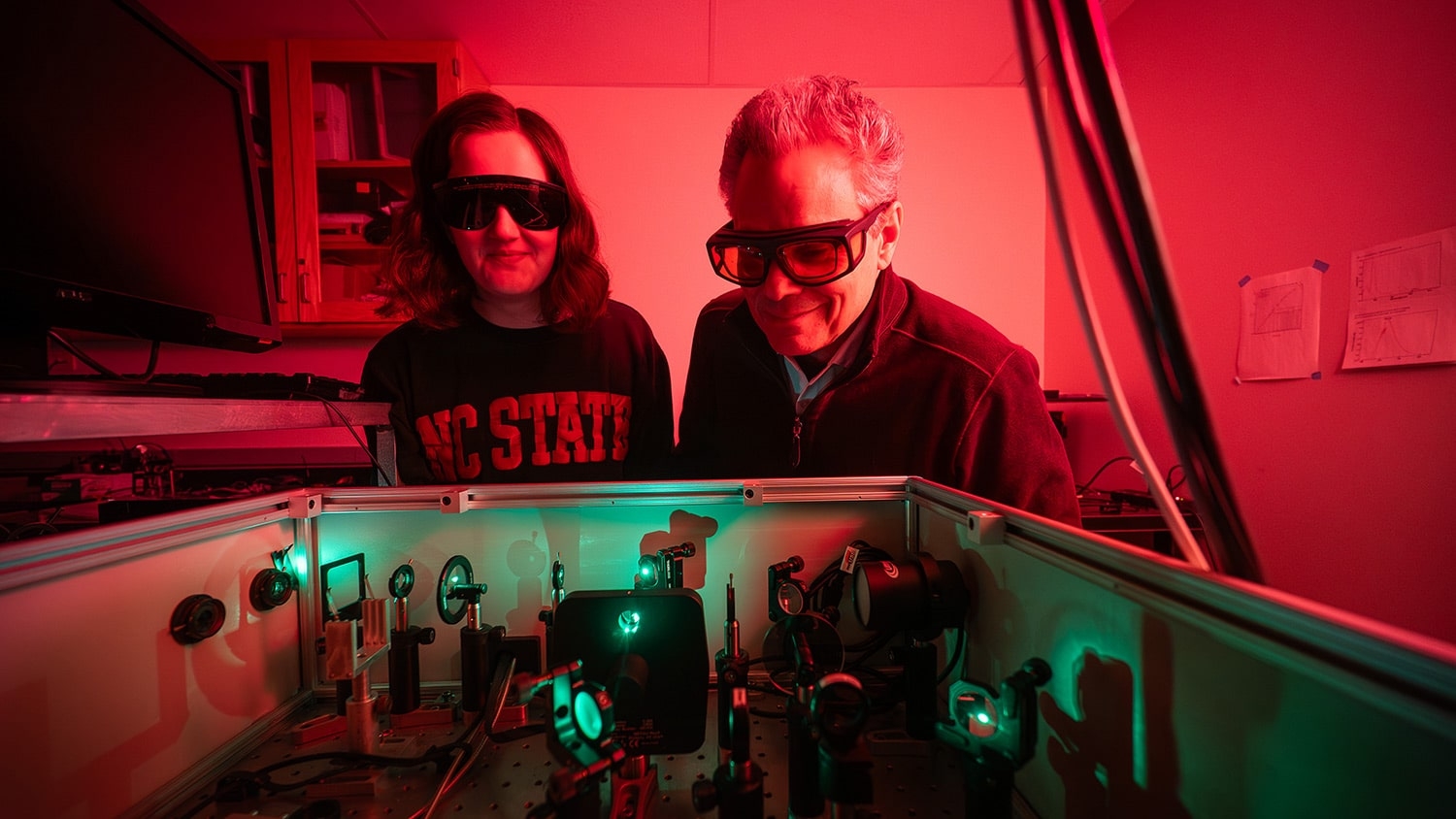
For students, conducting research at NC State is a chance to work alongside some of the world’s top scholars. This work often comes with a perk: Seeing your name alongside those researchers as an author in Science, Nature and other top journals.
Publishing in these journals — which includes a painstaking editing and review process that can take a year or more — can enhance students’ career prospects, whether they’re pursuing jobs in academia or industry. An impressive publication record tells prospective employers that these applicants have played in the big leagues of science, and that they’re ready for more.
“It conveys that I can collaborate with other people, work in the forefront of a scientific field and bring ideas,” said Sarah Kromer, a Ph.D. student in chemistry. “It’s beneficial and sets a good standard.”
Kromer is among about 100 current graduate and undergraduate students who conduct research alongside faculty in NC State’s Organic and Carbon Electronics Laboratory, known as ORaCEL. The research cluster has been particularly successful in publishing breakthroughs in the most prestigious journals, having co-authored 19 papers in the Science, Nature and Nature disciplinary journals over the past five years, 12 of which were led by ORaCEL faculty.
The generational mix of ORaCEL’s researchers contributes to this success. The group includes distinguished professors, mid-career and junior faculty, plus many postdocs and students who refine ideas and carry out the experiments. The researchers span multiple colleges and the departments of Chemistry, Materials Science and Engineering, Mechanical and Aerospace Engineering, and Physics and Astronomy.
The cluster is led by Harald Ade, Goodnight Innovation Distinguished Professor in the Department of Physics and Astronomy. Ade has been named among the world’s most highly cited researchers for the past several years, as has fellow cluster member Aram Amassian in the Department of Materials Science and Engineering.
Other cluster members have also accumulated impressive publication records. One example is physicist Dali Sun, who since 2023 has had papers in Science, Nature Materials and Nature Physics. The group’s state-of-the-art interdisciplinary facilities on Centennial Campus help attract top students and give these talented researchers the space to thrive.
“These investments by the university are critical to achieving a high intensity, mutually reinforcing culture of excellence,” Ade said.
‘Good People Have a lot of Impact’
Sarah Kromer wanted to work with heavy hitters in photochemistry. She had become hooked on the field, which focuses on the chemical effects of light, while pursuing her undergraduate degree at Binghamton University.
Among the faculty she was drawn to was Phil Castellano, Goodnight Innovation Distinguished Chair in the Department of Chemistry at NC State. Castellano’s research group studies how molecules behave when they’re exposed to light, and then attempts to manipulate that energized state into something useful. The group’s findings have implications for fields ranging from solar energy conversion to cancer treatment.
Kromer liked what she saw and joined the group in 2021. Almost immediately, she established herself as a hardworking star in the lab and was constantly thinking about new experiments. Castellano noticed that she took the inevitable failures in stride, letting them bounce off her and propelling her to seek out new hypotheses and techniques.
“What I’ve really learned is that negative information is still information,” Kromer said. “So if you fail, it still tells you something about the experience.”

Her successes are borne out by an impressive list of publications, including a 2023 paper in Nature for which she was a coauthor. The paper was the first to demonstrate the relationship between electron and nuclear motion on very fast time scales. The work could be applied in solar energy conversion, electronic displays and other areas.
Key to Kromer’s success has been her collaborative nature. She has worked with researchers at universities across the world and here in the United States, including at Argonne National Laboratory in Illinois and SLAC National Accelerator Laboratory in California. At NC State, she’s been involved with chemists, spectroscopists and engineers, as well as graduate and undergraduate students at various stages in their research careers.
“Those seedlings hopefully grow and emulate what they see in Sarah,” Castellano said. “And if they do, they’ll likely be successful.”
Looking ahead, Kromer hopes to move into industry, where she can parlay her impressive publication record into applications that can create clean energy.
“Good people have a lot of impact,” Castellano said.
A Continuing Collaboration
While considering offers from several graduate schools, Masoud Ghasemi kept liking what he saw in the physics, materials science and engineering programs at NC State. He also found the weather appealingly similar to his hometown near the Caspian Sea in Iran. Raleigh, he decided, would be his new home.
His advisor was Ade, whose research seeks to advance organic semiconductors and photovoltaics, with the goal of developing off-grid energy sources and electronics for military and civilian use. Ghasemi credits Ade not only with enhancing his scientific knowledge, but also with helping him learn about how to navigate U.S. research culture.
“Harald is amazing,” Ghasemi said. “I learned so much from him.”
Ghasemi earned his Ph.D. in 2018 and stayed on at NC State to pursue postdoctoral work. Eventually, he took another postdoctoral position at Pennsylvania State University, and in both of those roles he built upon his work as a graduate student at the junction of organic electronics and polymer science.
These are ever-changing fields. Organic solar cells have become much more efficient over the past several decades, but researchers and manufacturers still struggle with determining which material combinations work best, and why.

In one Nature Materials paper published in 2025, Ghasemi was part of a team of researchers, including Ade, who created phase diagrams for organic solar cells based on a composite of a polymeric semiconductor and a “small molecule acceptor.” The work shows that the mixing behavior of these composites can have an unexpected dependence on the temperature, indicating that researchers should consider additional factors when trying to predict material performance. The research could accelerate the development of improved materials for use in high-efficiency solar cells.
Like many postdocs, Ghasemi sees several career paths before him. He could remain in academia and pursue a faculty position, or focus on industry where he can translate his work into products that help people. His NC State graduate education, and his work with Ade and others in the ORaCEL group, helped prepare him for what’s next.
“Going to NC State and working with Harald was one of the best choices of my life,” Ghasemi said. “If I had to go back, I would definitely make the same choice over and over.”
Benefiting from a Background in Theory
Mustafa Türe arrived at NC State thinking he would pursue his graduate degree in theoretical particle physics. He ended up doing something different.
Türe initially joined the research group of Mithat Ünsal to study quantum field theory. But then he took a class with Kenan Gundogdu, who studies nanoscience and condensed matter physics. Casual conversations after class turned into actual research, and Türe joined Gundogdu’s group. Ünsal encouraged Türe and supported the move.
Much of the resulting collaboration involved applying Türe’s theoretical knowledge to Gundogdu’s pioneering experimental data.
Gundogdu and others had previously determined that the atomic structure of some hybrid perovskites, which have organic or inorganic cations with different halide components, protected groups of quantum particles from the thermal noise long enough to prompt a phase transition. In these materials, large polarons – groups of atoms bound to electrons – formed, insulating light emitting dipoles from thermal interference and allowing for superfluorescence to occur.

In the new study, published in Nature, Türe’s background in physics theory helped the researchers explain how the creation and preservation of a coherent quantum state actually works. The study could serve as a blueprint for designing materials that allow exotic quantum states such as superconductivity or superfluorescence at high temperatures. That could pave the way for applications such as quantum computers that don’t require extremely low temperatures to operate.
“So Mustafa gets a chance to work in the lab, see real experimental results, and then he was also able to apply theoretical tools,” Gundogdu said. “At the end of the day, it turned out it was feasible, which made a very substantial impact on the publication of our paper.”
For Türe, the change wasn’t easy. His learning curve was steep and there were several months during which he and Gundogdu, with their different physics backgrounds, were just trying to “understand what the other was saying,” Türe said.
“Making that transition is very scary,” Türe remembered. “There were times when I thought, ‘Can I do this?’”
But Gundogdu was a supportive mentor, and he found that he was learning as much from Türe as Türe was learning from him. Türe’s work in two different areas of physics ended up earning him the Philbrick Outstanding Graduate Research Assistant Award from his department.
“This is just the beginning,” Türe said. “I feel like we’re opening up a new research field.”
This post was originally published in NC State News.